

Practical solutions to maintain independence, confidence, and connection
By Dr. Dennis Denick, OD, Dipl ABO, FIALVS – Founder, Low Vision of Southwest Florida
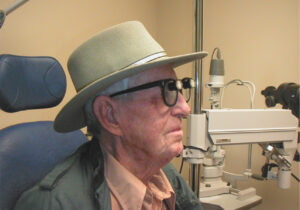 WHEN VISION LOSS CHANGES MORE THAN WHAT YOU SEE
For many people living with macular degeneration, the biggest changes aren’t always what they see—they’re what they stop doing.
Macular degeneration—along with conditions such as diabetic retinopathy, glaucoma, stroke-related vision loss, retinitis pigmentosa, and albinism — doesn’t just affect eyesight; it can change how people live their daily lives.
“If your glasses no longer help and you’ve been told ‘nothing more can be done,’ there may still be options to help you see and function better.”
Many patients begin to notice difficulty with everyday activities like reading, recognizing faces, watching television, or driving. Even when objects are still visible, they may be harder to process clearly and efficiently.
As these challenges increase, people often begin to adjust their routines—sometimes without realizing it. Activities become less frequent, outings are limited, and confidence may begin to decline.
THE SUBTLE CHANGES THAT ADD UP
One of the earliest changes is often reading.
You may still see the words, but they don’t come together as smoothly. Reading becomes slower and more tiring. You may lose your place more often or begin to avoid it altogether.
Other common challenges include:
• Difficulty recognizing faces
• Trouble following television programs
• Reduced confidence in unfamiliar environments
• Avoiding driving due to safety concerns
Over time, these changes can lead to less activity, fewer social interactions, and a gradual loss of independence.
MORE THAN AN EYE CONDITION
Vision plays a key role in how we stay engaged with the world around us.
As vision declines, people may begin to withdraw from activities they once enjoyed—whether it’s reading, attending events, or simply running errands. This reduced engagement can affect overall well-being and quality of life.
Addressing functional vision challenges early can help people stay active, involved, and connected.
A FORT MYERS SUCCESS STORY
Joseph B., an 82-year-old Fort Myers resident, enjoyed attending his grandchildren’s sporting events but began to struggle as his vision declined.
He found it increasingly difficult to distinguish his grandchild from the other players on the field, which took away much of the enjoyment of those moments. At the same time, he lost confidence in driving and began avoiding trips to the grocery store, where navigating the aisles became challenging.
As his activities became more limited, he felt less connected to the people and routines that were important to him.
After a comprehensive low vision evaluation, Joseph was prescribed a custom bioptic telescope to assist with distance vision. With proper fitting and training, he experienced a meaningful improvement in his ability to see detail.
He is now able to follow his grandchildren more easily during their games, drive with greater confidence, and move through the grocery store more comfortably.
“I can finally pick my grandchild out on the field again,” he said. “That means everything to me.”
Joseph reports feeling more independent, more confident, and reconnected to the activities he enjoys most.
Individual results may vary based on diagnosis and remaining vision.
WHAT CAN HELP?
When glasses or surgery are no longer enough, low vision rehabilitation focuses on improving how you use your remaining vision.
A FORT MYERS SUCCESS STORY
Joseph B., an 82-year-old Fort Myers resident, enjoyed attending his grandchildren’s sporting events but began to struggle as his vision declined.
He found it increasingly difficult to distinguish his grandchild from the other players on the field, which took away much of the enjoyment of those moments. At the same time, he lost confidence in driving and began avoiding trips to the grocery store, where navigating the aisles became challenging.
As his activities became more limited, he felt less connected to the people and routines that were important to him.
After a comprehensive low vision evaluation, Joseph was prescribed a custom bioptic telescope to assist with distance vision. With proper fitting and training, he experienced a meaningful improvement in his ability to see detail.
He is now able to follow his grandchildren more easily during their games, drive with greater confidence, and move through the grocery store more comfortably.
“I can finally pick my grandchild out on the field again,” he said. “That means everything to me.”
Joseph reports feeling more independent, more confident, and reconnected to the activities he enjoys most.
Individual results may vary based on diagnosis and remaining vision.
WHAT CAN HELP?
When glasses or surgery are no longer enough, low vision rehabilitation focuses on improving how you use your remaining vision.
A key part of the process is identifying your goals—what you want to be able to do again. For some, it’s reading comfortably. For others, it’s recognizing faces, watching television, or continuing to drive.
With specialized optical devices, improved lighting, and personalized strategies, many patients are able to return to meaningful daily activities.
MODERN TOOLS THAT MAKE A DIFFERENCE
Today’s low vision options go far beyond simple magnifiers.
Solutions may include bioptic telescopic glasses, telemicroscopes for near tasks, electronic magnification, and contrast-enhancing filters.
With the right tools and training, many patients experience meaningful improvements in what they can see and do.
A TEAM APPROACH TO CARE
Low vision care works alongside your eye doctor’s medical treatment.
While your ophthalmologist and optometrist focus on preserving eye health and managing disease, low vision rehabilitation focuses on helping you function more comfortably and effectively in daily life.
STAYING ACTIVE, STAYING CONNECTED
Vision loss can change how you see the world—but it doesn’t have to mean stepping away from it.
With the right evaluation, tools, and guidance, many people are able to stay active, independent, and connected to the people and activities that matter most.
With the right support and tools, many of those activities don’t have to be given up—they can be regained, helping people stay connected to what matters most.
SCHEDULE YOUR COMPREHENSIVE LOW VISION EVALUATION – Dr. Dennis Denick, OD, Dipl ABO, FIALVS
Low Vision of Southwest Florida
(941) 799-8044
www.lowvisionofswfl.com
(Located inside Eye Centers of Florida)
4101 Evans Ave, Fort Myers, FL 33901
If you have been told “nothing more can be done,” a Low Vision evaluation may help you explore additional options. Appointments are limited.