

By Dr. Lori DeBlasi, DPM, FACFAS
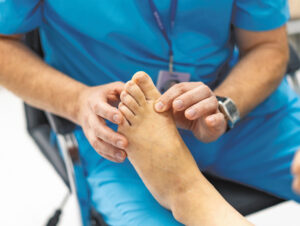 While we often associate skin cancer with the face or shoulders, it can develop anywhere on the body, including the ankles and feet. Because the feet are frequently overlooked during routine medical checkups, staying vigilant through regular self-exams is vital for early detection.
Common Types and Symptoms
Skin cancer on the lower extremities can be deceptive, often mimicking common conditions like warts, calluses, or fungal infections.
Basal Cell Carcinoma (BCC) is among the least aggressive forms and is less common on the feet than other areas. When it does appear, it typically looks like a pearly white bump or a patch of bumps that may ooze or crust over like an open sore.
Squamous Cell Carcinoma (SCC) is the most common form of cancer found on the skin of the feet. In its early stages, it usually remains confined to the skin, but advanced cases can become aggressive. On the feet, SCC often resembles a scaly bump, plaque, or even eczema. While usually painless, these spots may be itchy, or they might crack and bleed.
Actinic Keratosis serves as a pre-cancerous warning sign. These lesions often feel like rough, sandpaper-like spots before they are even visible. They can be flat or slightly raised, ranging in color from tan to pink, eventually developing into reddish, scaly plaques.
Malignant Melanoma is the most dangerous form of skin cancer due to its ability to spread to deeper tissues. It can appear on the tops or soles of the feet, and occasionally manifests beneath a toenail as a dark vertical line.
The ABCDEs of Melanoma
When inspecting moles or spots on your feet, remember this guide to identify suspicious changes:
• Asymmetry: One half of the lesion does not match the other.
• Borders: The edges are ragged, notched, or blurred.
• Color: The color is uneven, featuring shades of black, brown, tan, or even red and blue.
• Diameter: The spot is larger than 6 mm (about the size of a pencil eraser).
• Evolution: The mole is changing in size, shape, color, or symptoms (like itching or bleeding).
Prevention and Professional Care
Protecting your feet requires the same diligence as the rest of your body. Use a water-resistant, broad-spectrum sunscreen of at least SPF 30 on your ankles and feet, and try to avoid the sun during peak hours between 10 am and 4 pm. Daily inspections of your toes and the spaces between them are essential, as any mole that changes or bleeds warrants a professional examination.
Podiatrists are uniquely trained as lower extremity specialists to recognize and treat these abnormal skin conditions. If you have concerns about a spot on your foot, Dr. Lori DeBlasi is available for consultations. She is certified by the American Board of Foot and Ankle Surgery® and sees patients at the Family Foot & Leg Center in Estero.
Family Foot and Leg Center
21401 Corkscrew Village Lane,
Suite 4
Estero, FL 33928
(239) 430 – 3668 (FOOT)
www.NaplesPodiatrist.com