

By Shannon WIllits, NPCP, FAFS
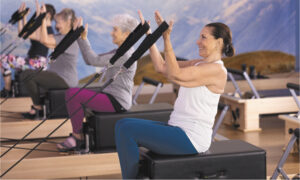 Breast cancer surgery changes more than breast tissue. Mastectomy and lumpectomy procedures disrupt the pectoral fascia, axillary lymph nodes, and the muscular sling that normally coordinates scapular movement. The result, for a significant portion of patients, is a predictable cluster of impairments: restricted shoulder flexion and abduction, tightness across the anterior chest wall, a forward-rounded resting posture, and in some cases axillary web syndrome, a palpable cording of tissue along the inner arm that limits extension. For patients who undergo axillary lymph node dissection, there is an added and lasting concern: lymphedema risk in the ipsilateral arm.
Pilates has drawn increasing attention as a rehabilitation tool for this population, not because it is trendy, but because its core mechanics map closely onto what post-mastectomy tissue needs: controlled, breath-linked movement through a deliberately limited range, with constant attention to scapular position rather than raw repetition.
The research base, while still modest, is instructive. A 2009 pilot study in the Journal of Bodywork and Movement Therapies found that breast cancer survivors completing a structured Pilates program showed measurable gains in shoulder range of motion, upper extremity function, and mood compared with non-exercising peers. A 2012 study in the Clinical Journal of Oncology Nursing enrolled fifteen postmastectomy survivors in a 12-week mat-based Pilates program and recorded statistically significant improvement in shoulder abduction and internal rotation on the affected side, along with gains in cervical rotation and flexion. A 2018 Brazilian cohort of 42 post-surgical patients found significant improvement in shoulder flexion, abduction, and external rotation after just 30 days, with continued gains through 90 days.
In practice, that means sequencing matters. In the earliest phase, typically once a surgeon has cleared movement, work should prioritize diaphragmatic breathing, scar tissue mobility, and gentle scapular setting, without loaded resistance on the affected side. As tissue heals and clearance progresses, usually in the six-to-eight-week range but always individualized to the patient’s surgical history and any reconstruction, controlled range-of-motion work can expand into flexion, abduction, and rotation, with the instructor monitoring for any change in arm circumference, heaviness, or skin texture. Spring resistance, when introduced, should be light and symmetric, avoiding the instinct to overload the unaffected side to compensate.
Thoracic extension work is particularly valuable here, since chest wall surgery and the protective posture that follows it tend to compound each other, flattening breathing mechanics and accelerating the forward-shoulder pattern.
None of this is a substitute for oncology follow-up or certified lymphedema therapy. It is a complement to it, and it depends on an instructor who has been specifically trained in post-surgical and oncology-informed movement rather than general mat certification alone. Patients considering this route should ask directly whether their instructor has that training, whether the studio communicates with their care team when needed, and how progression is tracked over time.
Recovery from mastectomy is not linear, and neither should the movement plan be. But for patients cleared to move, precise, breath-driven work aimed at the specific mechanics disrupted by surgery offers a measurable path back to shoulder function, posture, and a sense of ownership over the body again. For many women rebuilding that relationship with their bodies, that starting point is worth seeking out.
………………………………………
Shannon Willits, Master Pilates Educator
Shannon Willits is a Master Pilates Educator with more than 25 years of experience in functional movement, rehabilitation-informed training, and athletic performance. As the owner of seven growing Club Pilates studios in Lee County, Florida, she has become one of the region’s leading voices in Pilates education, mentoring and certifying aspiring instructors through comprehensive training programs rooted in movement science.
Shannon is STOTT Pilates certified, a Fellow of Applied Functional Science (FAFS), a Functional Golf Specialist, and a certified Gyrotonic® instructor. She is also an approved NPCP CEC Provider and the creator of the Pilates for Rotational Sports workshop, which blends performance training, injury prevention, and functional movement education for both athletes and instructors.
Official Recommendations
ACSM Exercise Guidelines for Cancer Survivors (2019 International Multidisciplinary Roundtable): 150 minutes of moderate-intensity aerobic activity per week, or 75 minutes of vigorous activity; 2–3 strength-training sessions per week targeting major muscle groups; flexibility work for major muscle groups on days other exercise is performed. The roundtable, convened by ACSM with the American Cancer Society and National Cancer Institute, emphasizes that exercise prescriptions be adapted to each survivor’s diagnosis, treatment history, and treatment-related side effects, not applied as a generic program.
American Cancer Society, “Exercises After Breast Cancer Surgery”: ACS recommends beginning specific shoulder and arm exercises within days of surgery, under physician guidance, including shoulder blade squeezes, pendulum swings, wall climbs, and overhead reaches, performed in short daily sets and progressed gradually over four to six weeks. Range is limited to shoulder height until any surgical drains are removed.
Where Pilates Fits.
These map directly onto Pilates fundamentals and are the movements most instructors will start with once a patient is cleared:
. Breath work: Diaphragmatic, rib-expansion breathing, the foundation of every Pilates exercise, supports lymphatic flow and re-teaches full chest wall expansion after surgery limits it.
. Shoulder mobility: Controlled arm circles and supported arm sweeps, done slowly and within pain-free range, echo the ACS pendulum and wall-climb progressions while adding breath coordination.
. Scapular stability: Seated or supine scapular isolation work, drawing the shoulder blades down and together without shrugging, builds the same stabilizing pattern as the ACS shoulder blade squeeze, with more precise cueing around symmetry and compensation.
Timeline: When Is It Safe to Begin?
. Gentle breathing and scar mobilization: often within the first two weeks, only with surgeon sign-off
. Controlled range-of-motion work: typically 6–8 weeks post-surgery, varies by procedure and reconstruction
. Loaded or resistance-based work: only after clearance from the surgical and oncology team, introduced gradually
Watch For
Any new heaviness, swelling, tightness, or skin change in the affected arm should be reported to the patient’s physician or certified lymphedema therapist before continuing exercise.