

What Should You Do With Your Old 401(k)?
By Rick Walker, Financial Planner & CPA, and Kimberlee Clark, Financial Planner
Changing jobs often brings a long list of decisions, and one that is frequently overlooked is what to do with your retirement savings. If you participated in a 401(k) or other employer-sponsored retirement plan, you generally have four options after leaving your employer.
There is no single “best” choice. The right decision depends on your financial goals, investment preferences, retirement timeline, tax considerations, and the features available within each retirement plan. Understanding your options can help you make an informed decision.
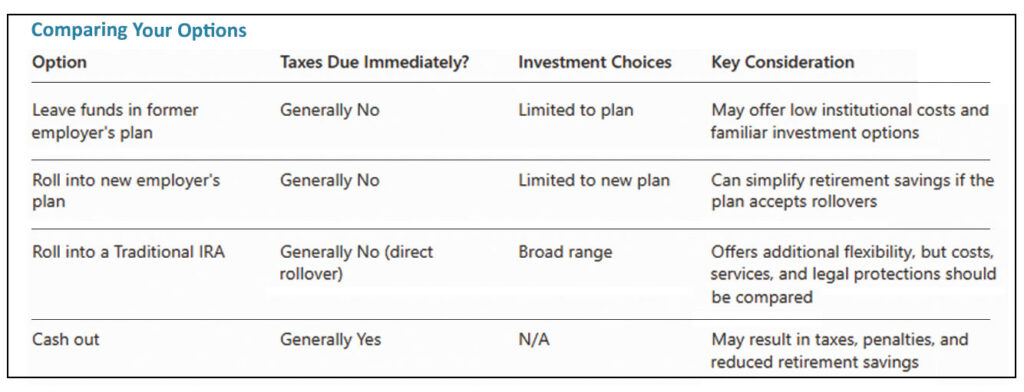
Option One: Leave Your Money in Your Former Employer’s Plan
Leaving your retirement savings with your former employer may be appropriate for some individuals.
Potential Advantages
• No immediate taxes or penalties.
• Employer-sponsored plans may offer institutional investment options with competitive expenses.
• Retirement savings continue growing tax-deferred.
Potential Considerations
• Investment choices are generally limited to the plan’s available options.
• Managing multiple retirement accounts over time may become more complicated.
Option Two: Roll the Assets Into Your New Employer’s Retirement Plan
If your new employer accepts rollovers, combining retirement savings into one workplace plan may simplify account management.
Potential Advantages
• Consolidates retirement assets into one account.
• Continues tax-deferred growth.
• Keeps retirement savings within an employer-sponsored retirement plan.
Potential Considerations
• Investment options, fees, and plan features vary by employer.
• Not all employer-sponsored plans accept incoming rollovers.
Option Three: Roll the Assets Into an Individual Retirement Account (IRA)
Some individuals choose to transfer retirement assets into a Traditional IRA through a direct rollover.
Potential Advantages
• Access to a broader selection of investment choices.
• May simplify retirement savings if multiple accounts have accumulated over time.
• Can provide additional flexibility when coordinating retirement income planning and beneficiary designations.
Potential Considerations
• Investment expenses and advisory fees may differ from those available in an employer-sponsored retirement plan.
• Some employer-sponsored plans may offer lower costs or different features than an IRA.
• Creditor protections, loan provisions, and distribution rules may differ between employer-sponsored retirement plans and IRAs.
A direct rollover from a traditional 401(k) to a traditional IRA generally does not create a taxable event, allowing retirement savings to continue growing tax-deferred.
The Bottom Line
An old 401(k) deserves more than an “out of sight, out of mind” approach. Each available option offers potential advantages and considerations, and the most appropriate choice depends on your individual circumstances.
Before making a decision, compare investment expenses, available investment options, services, withdrawal flexibility, tax implications, and other plan features. Taking time to evaluate all four options can help ensure your retirement savings remain aligned with your long-term financial goals.
We are here to help you navigate these investment options and find the best option for you! Call us to discuss your options and join us at our next luncheon on August 25th at Season 52 in Naples.
239-434-6613
4933 N. Tamiami Trail, Suite 202, Naples, FL 34103
NaplesWealthStrategies.com