

How low vision rehabilitation helps people stay active, engaged, and independent—even when standard treatments are no longer enough
By Dr. Dennis Denick, OD, Dipl ABO, FIALVS – Founder, Low Vision of Southwest Florida
 Have You Been Told “There’s Nothing More That Can Be Done”?
If you have macular degeneration, geographic atrophy, diabetic retinopathy, glaucoma, or another eye condition—and glasses or surgery are no longer helping—you’re not alone.
Many patients feel frustrated or discouraged at this stage.
Low vision rehabilitation focuses on helping people make better use of the vision they still have. Using specialized devices and personalized training, many patients are able to return to activities that are important to them and maintain their independence.
Vision Loss Affects More Than Just Eyesight
One of the first things many people notice is that reading becomes harder.
You may still be able to see the words—but they don’t come together as easily. Reading feels slower, more tiring, and less enjoyable. Even activities like crossword puzzles or watching television can become frustrating.
Over time, vision loss can lead to reduced independence, social withdrawal, and feelings of depression. Staying visually active—especially with reading—
helps keep the mind engaged and supports emotional well-being.
Vision Changes in Parkinson’s Disease
In recognition of Parkinson’s Awareness Month, it’s important to understand that vision problems are not always caused by eye disease alone.
Parkinson’s disease can affect how the eyes and brain work together. People may notice reduced contrast (things appear faded), difficulty tracking lines of text, decreased blinking leading to dry eyes, and problems judging distances.
These changes can make everyday activities—like reading, walking safely, or navigating new environments—more difficult, even if an eye chart still looks fairly good.
Simple strategies such as improved lighting, increased contrast, and appropriate magnification can make a meaningful difference. In some cases, working alongside occupational therapy can further improve daily function.
A Fort Myers Success Story
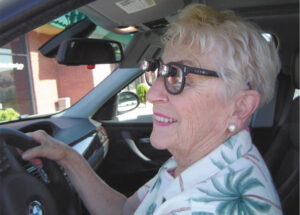
Jane L., an 84-year-old Fort Myers resident who lives independently, began noticing worsening vision from macular degeneration. Even with new glasses, she continued to struggle.
She no longer felt safe driving and began avoiding trips to the grocery store and medical appointments. Over time, she became more isolated and discouraged, as she was no longer able to visit friends or maintain her usual routine.
After a low vision evaluation, she was prescribed a custom bioptic telescope to assist with distance vision. With proper fitting and training, she experienced significant improvement in her ability to see detail and road signs while driving.
“I can see detail and street signs so much better,” she reported.
She also noticed improved ability to recognize faces and watch television more comfortably.
For near tasks, a telemicroscope was prescribed to help with reading and cell phone use, allowing her to stay connected and manage daily activities more easily.
Jane reports feeling more confident, less isolated, and better able to maintain her independence.
Individual results may vary based on diagnosis and remaining vision.
What Is Low Vision Care?
When glasses or surgery are no longer enough, low vision care focuses on improving how you use your remaining vision.
A key part of the evaluation is identifying your goals—whether it’s reading, watching television, recognizing faces, or continuing to drive or work.
Solutions are customized based on your vision and your daily needs.
Advanced Low Vision Technology Available in Southwest Florida
Today’s low vision tools go far beyond simple magnifiers.
Options may include bioptic telescopic glasses, reading microscopes, telemicroscopes, electronic magnification systems, prism side-vision awareness lenses, and contrast-enhancing filters.
With the right tools, many patients experience meaningful improvements in what they can see and do.
A Team Approach to Better Vision
Low vision care works alongside your eye doctor’s medical treatment.
While your ophthalmologist and optometrist focus on preserving eye health and managing disease, low vision rehabilitation focuses on helping you function more comfortably and effectively in daily life.
In some cases, collaboration with other professionals—such as occupational therapists—can further enhance safety, confidence, and independence.
Seeing Better. Living Better.
Vision loss can change how you see the world—but it doesn’t have to mean giving up the things you enjoy.
With the right evaluation, tools, and guidance, many people are able to stay active, independent, and engaged.
Early help is important, as changes in how you use your vision may not always show up on a standard eye chart.
Schedule Your Comprehensive Low Vision Evaluation:
Dr. Dennis Denick, OD, Dipl ABO, FIALVS
Low Vision of Southwest Florida
(941) 799-8044
www.lowvisionofswfl.com
(Located inside Eye Centers of Florida)
4101 Evans Ave, Fort Myers, FL 33901
If you have been told “nothing more can be done,” a Low Vision evaluation may help you explore additional options.
Appointments are limited.
Specialized care for macular degeneration, diabetic retinopathy, glaucoma, and other vision-limiting conditions.