

By Dr. Ernesto Eusebio
 Sleeping Better sounds like a simple set of instructions, but as we will discuss in this article, sleeping better is a far more complicated task than it seems.
From a philosophical standpoint, sleep is something that interrupts our perceived existence, as during this time we are unconscious and unable to interact with the environment, perform our duties to self and community, and to live those precious moments with our loved ones. During sleep we are vulnerable to the environment. We change our role from predator to prey. And all living things sleep in one way or another.
Even though there is still a lot to learn about sleep, we do know it is extremely important to preserve optimal brain and body functions. It is so important that we stop living our lives, and sometimes place ourselves in danger, so it can happen.
For eons, sleep has evolved with us to the way we now see it. Most of us spend roughly 1/3 of our lives sleeping. In the US, as of 2023, life expectancy is 77.5 years. This adds to roughly 25-30 years sleeping. Remarkably, we never stop to wonder what really happens in our sleep, we simply assume that sleep is the time where we rest and “recharge”.
During sleep we are unconscious, so we operate under a series of assumptions: we assume we slept X hours, we assume we slept enough or not enough, we assume we sleep well or poorly, or we may assume our sleep is good or bad. But the truth is we just don’t know, how can we “sleep better” if we can’t even see that we are sleeping poorly?
We also judge our sleep based on the assumption that sleep is a way to address fatigue and tiredness. We tend to see sleep the way we see placing a cell phone on a charger, “I sleep and I should feel restored tomorrow”. But what happens when the source of this fatigue is not sleepiness?
Unfortunately, all these assumptions often result in efforts to improve sleep that in fact lead to worse sleep than what we had going on before. We call these “maladaptive sleep behaviors”, which often herald Insomnia.
This brings us to another dilemma; how can we make sleep better if our sleep is damaged with sleep disorders such as Insomnia, sleep apnea, restless legs, circadian rhythm disorders, narcolepsy, hypersomnia, sleep disturbances due to other medical conditions, sleep disturbances due to medications, etc.
If you think you have a sleep problem, you should see your local sleep doctor. This article is not intended to help you diagnose or treat a sleep disorder, but is intended to provide with tips to optimize sleep when such disorders are not present.
I like to refer to this as Sleep Optimization. We can’t always make sleep better, but we can always optimize it. We can help you reach your best sleep. Here are some tips to do this:
1. Internal Clock Optimization:
Maintain a consistent sleep schedule, with particular attention to wake-up time, and with light exposure immediately upon awakening. This is how you set your circadian clock/rhythm. If your circadian rhythm does not match your sleep schedule, you will never have optimal sleep. Best example of a circadian-rhythm/sleep-schedule mismatch: Jet Lag.
2. Time in Bed Optimization:
We recommend a sleep schedule that is age appropriate, allows for enough time asleep, and minimizes time spent awake in bed.
Please note I am referring to time in bed, not sleep time.
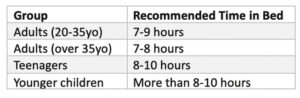
It is important to note that sleep needs vary by individual. See a sleep doctor if you consistently feel tired after sleeping or if you spend too much time awake in bed.
3. Behavioral Optimization:
a. Before Bed: A sleep ritual for 1-2 hours before bed, if possible, sets the stage to sleep. Lower temperature to the sleep ideal 67F, dim lights, get ready early and focus on relaxing activities that you enjoy.
b. At Bedtime: Limit activities in bed to sleep and sex only. Activities like watching TV are trained behaviors (think of it as an adult version of a pacifier to sleep), that can easily be removed so that people just fall asleep in bed.
Reading can improve perceived sleep quality, but not actual sleep amount. So it is better to read than to watch TV.
c. During Sleep Time: If one wakes up, it may be best not to stay in bed and take a “sleep break”, like a reverse nap, where you may get up and read for 20-30 minutes at a time and then return to bed to sleep.
4. Adopt Stress Management Strategies:
Simple stress management strategies such as Gratitude Practice and Mindfulness Meditation can help reduce stress, improve sleep, restore some brain functions, reduce anxiety, among other things. Incorporating these into our wake time can often help us optimize the time we spend in bed, even when we are not actually sleeping.
Accepting New Patients!
Sleep & Apnea Insitute of Florida
(239)788-6500
www.saifsleep.com
23421 Walden Center Dr, Suite 100
Bonita Springs, FL 34134