

 It’s not normal to suddenly find yourself gasping for breath during activities you can usually handle. Sure, as we age, physical exertion becomes more challenging. However, this decline should be a gradual process. If you had no problem bringing your groceries into your home last week and suddenly find that same chore difficult today, you should see your doctor. A faulty heart valve might be making your heart work too hard.
According to AdventHealth board-certified cardiothoracic surgeon Dr. Paul DiGiorgi, one common culprit is a hardened aortic valve, which can lead to a condition called aortic stenosis — a narrowing of the valve that restricts blood flow through the body’s largest artery.
More than 200,000 cases of aortic valve stenosis will be diagnosed in the United States this year. Valves are like doors with hinges that help blood move in the right direction throughout the body. However, sometimes those hinges become too loose, causing blood to leak back in the wrong direction.
The Dangers of Aortic Valve Stenosis
Aortic valve stenosis is a serious heart condition where the valve that controls blood flow from the heart to the rest of the body becomes narrowed. This narrowing forces the heart to work harder to pump blood, which can lead to fatigue, chest pain, and shortness of breath — especially during everyday activities.
According to Dr. DiGiorgi, patients often don’t recognize the severity of their symptoms until they begin to experience noticeable limitations in their daily routines. Left untreated, aortic stenosis can progress quickly and lead to heart failure, but with timely intervention, outcomes are often very positive.
Aortic Valve Repair and Replacement
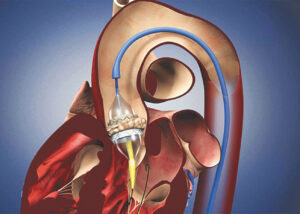
“Treatment typically involves repairing or replacing the damaged valve. In many cases, minimally invasive procedures like transcatheter aortic valve replacement (TAVR) are recommended. This approach allows surgeons to insert a new valve through a small incision in the groin, guiding it to the heart via a catheter. Once in place, the new valve restores proper blood flow with significantly less recovery time than traditional open-heart surgery,” says Dr. DiGiorgi.
TAVR was first approved by the FDA in 2011 for patients who were too high-risk for open-heart surgery due to age or health conditions. Over time, as studies confirmed its safety and effectiveness, the procedure became available to intermediate- and low-risk patients, with full approval for all risk levels by 2019. Today, TAVR is even used in select asymptomatic patients, offering a minimally invasive option with excellent outcomes.
While TAVR has become a widely accepted treatment for aortic stenosis — even in low-risk and asymptomatic patients — it may not be the best option for younger individuals, especially those under 65. One reason is that the long-term durability of TAVR valves is still being studied, with current data showing strong performance for up to 10 years. A second TAVR procedure (valve-in-valve) is often possible if the first valve wears out, but the feasibility of a third replacement remains uncertain and depends on individual anatomy and valve size.
Whether through TAVR or open surgery, once the aortic valve is working well again, the heart muscle thins back out as normal.
We’re Here to Ease Your Mind and Heal Your Heart
If you have a heart condition such as aortic stenosis that might require cardiac surgery, the experts at AdventHealth Port Charlotte are here to help. To learn more, visit AdventHealthPortCharlotte.com or call 941-766-5095 to schedule an appointment with Dr. DiGiorgi.