

By Dr. Ron Adduru, DPM – Family Foot & Leg Center
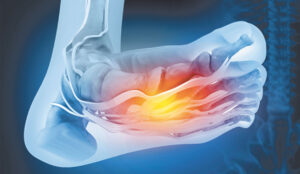 For years, the conversation around peripheral neuropathy was frustratingly brief: “Keep your blood sugar stable and take this medication to numb the pain.” As a podiatrist, I’ve seen the toll this “management” takes on patients—the sleepless nights due to burning sensations, the loss of balance, and the fear of a wound they can’t even feel.
But the landscape of 2026 is different. We have moved past simply masking symptoms. Today, our goal is neuro-regeneration and modulation. We aren’t just quieting the alarm; we are trying to fix the wiring.
Understanding the “Static” in Your System
To fix the problem, we first have to understand what is actually happening. Imagine your nervous system as a complex network of electrical cables running from your spine to your toes. Peripheral Neuropathy is essentially “line noise” or damage to those cables.
When the protective coating (myelin) or the wire itself (the axon) is damaged, the signals get garbled. Your brain might receive a “burning” signal even though your feet are cold, or it might receive no signal at all, leaving you feeling like you’re walking on cotton wool or blocks of wood.
Why Is This Happening to Me?
Neuropathy doesn’t happen in a vacuum. It is usually a symptom of an underlying “thief” stealing your nerve health. Common culprits include:
. Diabetes (The Most Common): High blood sugar acts like “shards of glass” in the bloodstream, damaging the tiny vessels that feed your nerves.
. Vitamin Deficiencies: Nerves require B12, B1, and B6 to function. Without them, the wiring begins to fray.
. Autoimmune Responses: Sometimes, the body’s own defense system mistakenly attacks the nerve tissue.
. Chemotherapy-Induced: Certain life-saving medications can unfortunately have a toxic “side effect” on peripheral nerve endings.
. Mechanical Compression: Much like a garden hose with a kink in it, physical pressure from tight anatomical tunnels can starve a nerve of its vital signals.
Breaking the “Numbing” Cycle: Moving Beyond the “Gabas”
For decades, the standard of care relied heavily on oral medications like Gabapentin (Neurontin), Pregabalin (Lyrica), and Duloxetine (Cymbalta). While these drugs can be helpful for some, many patients find the side effects—brain fog, drowsiness, weight gain, and “feeling like a zombie”—to be as debilitating as the neuropathy itself. Furthermore, these medications do not heal the nerve. They simply turn down the volume of the pain signal in the brain. In 2026, we aim higher. We want to address the nerve at the source rather than just sedating the patient’s perception of the problem.
The 2026 Treatment Protocol
1. The “Fuel” Protocol: Advanced Nutraceuticals
Nerves are high-maintenance cells. If they don’t have the specific molecular building blocks they need, they cannot repair.
. Alpha-Lipoic Acid (ALA): This “universal antioxidant” remains the gold standard for reducing oxidative stress.
. Benfotiamine: A fat-soluble form of B1 that penetrates nerve membranes far more effectively than standard supplements.
. Methylated B-Vitamins: We use pre-activated forms (Methylcobalamin) to ensure your body can bypass genetic absorption hurdles.
2. Precision Mapping: Hydrodissection & Diagnostic Injections
Before we move to advanced stimulation, we must prove exactly which nerve is the culprit. We perform a diagnostic nerve block using a local anesthetic under ultrasound guidance.
During this process, we often utilize Hydrodissection. This involves injecting a small amount of fluid (usually saline and anesthetic) to physically separate the nerve from surrounding scar tissue or tight fascia.
. The “Test Drive”: If your pain vanishes for several hours following this injection, we have a “positive map.” This confirms that a Peripheral Nerve Stimulator (PNS) will be highly effective for you.
3. Neuromodulation: Peripheral Nerve Stimulators (PNS)
Once the diagnostic block confirms the target, we use PNS technology. This is a tiny, lead-thin device placed near the nerve via a minimally invasive procedure.
. How it works: It sends mild electrical pulses that “interrupt” pain signals. It’s like a noise-canceling headphone for your feet, allowing you to bypass the need for heavy oral sedatives.
4. Regenerative Modalities: Lasers and Light
We utilize Class IV High-Intensity Laser Therapy (HILT). These medical-grade lasers trigger angiogenesis—the growth of new tiny blood vessels. By increasing micro-circulation, we are “watering the garden” of your nerve endings, providing the oxygen they need to heal naturally.
5. Structural Decompression: Releasing the Pressure
If hydrodissection shows the nerve is physically trapped, we may perform Nerve Decompression Surgery. By widening the tight tunnels in the ankle, we give the nerve room to breathe, often restoring sensation that was previously thought lost.
The Bottom Line
You don’t have to choose between burning pain and a “Gabapentin fog.” From targeted nutrient repair to ultrasound-guided hydrodissection and wireless nerve stimulation, the toolkit of a modern podiatrist is deeper than ever.
Don’t wait for the numbness to become permanent. Your feet are your foundation—let’s start rebuilding them.
Dr. Ron Adduru is a podiatrist at Family Foot & Leg Center in Sarasota, Florida, specializing in complex wound care and deformity reconstruction. He is
committed to helping the Sarasota community remain active and healthy.
3110 Fruitville Commons Blvd
Suite 102
Sarasota, FL 34240
(239) 430 – 3668 (FOOT)
www.NaplesPodiatrist.com