

By Shannon Willits, Master Pilates Educator
 November is American Diabetes Month, and this year the conversation looks different. Medications such as semaglutide and tirzepatide have changed how millions of Americans manage blood sugar and body weight. According to the CDC, 38.4 million Americans live with diabetes and an estimated 97.6 million adults have prediabetes. Many of them now face a question earlier generations never had to ask: how does a person lose weight on medication without losing the tissue that controls blood sugar in the first place?
The answer sits in skeletal muscle.
Muscle Is a Metabolic Organ
Skeletal muscle accounts for roughly 80 percent of insulin-stimulated glucose uptake after a meal. It is the body’s largest site for glucose disposal and storage. When muscle mass declines, the body loses capacity to clear sugar from the bloodstream, and the pancreas must work harder to produce the same result.
Muscle contraction also opens a second door. During work, muscle fibers move GLUT4 glucose transporters to the cell surface through a pathway that does not depend on insulin. This is why a single resistance session can lower blood glucose even in people with significant insulin resistance. The American Diabetes Association Standards of Care recommend resistance training two to three times per week on nonconsecutive days for adults with type 2 diabetes, in addition to aerobic activity.
What the Medication Trials Show
GLP-1 receptor agonists produce substantial weight loss, and not all of that weight is fat. In the STEP 1 trial’s body composition substudy, lean mass accounted for roughly 39 percent of total weight lost with semaglutide. In SURMOUNT-1, lean mass made up approximately 25 percent of weight lost with tirzepatide.
Those numbers deserve careful interpretation. DXA scans measure lean mass, a category that includes water, glycogen, organ tissue, and fat stored inside muscle fibers, so contractile muscle is only part of the figure. Some of that loss reflects a healthier liver and less intramuscular fat. The direction is still clear. Rapid weight loss without a strength stimulus places muscle at risk, and adults over 40 can least afford it. After age 30, adults lose an estimated three to eight percent of muscle mass per decade. For women, declining estrogen across perimenopause and menopause accelerates both muscle loss and insulin resistance and tends to shift fat storage toward the abdomen.
A woman who loses 30 pounds while losing meaningful muscle may see a better number on the scale and a weaker metabolic engine underneath it.
Why Load Quality Matters
Muscle responds to mechanical tension. Effective resistance training for metabolic health does not require a barbell, but it does require progressive load, time under tension, and enough challenge that the final repetitions feel demanding.
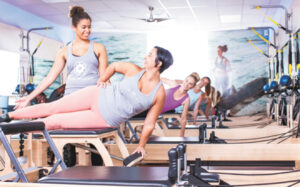
The Pilates reformer is a resistance machine. Springs provide adjustable load through both the shortening and lengthening phase of each movement, and controlled eccentric work is well tolerated by older adults while remaining highly effective for building muscle and tendon. Footwork, leg presses, rowing series, and long box work load the largest muscle groups in the body: the quadriceps, gluteals, hamstrings, and back extensors. These are also the tissues with the greatest capacity for glucose uptake.
Equally important is the organization around the load. Movement educator Madeline Black has long taught that efficient force production depends on a well-organized center. Pilates trains breath, trunk stability, and joint alignment alongside strength, which allows people with neuropathy, joint pain, or low baseline fitness to train with real intensity. For many adults beginning a GLP-1, joint comfort determines whether they keep showing up.
Protein and the Training Signal
Muscle needs two inputs to remain: a training stimulus and enough dietary protein to rebuild. Appetite suppression on GLP-1 medications can make adequate protein difficult to reach. Many clinicians now advise prioritizing protein at every meal while on these medications, with targets set individually by the prescribing provider or a registered dietitian. Training without adequate protein limits adaptation, and protein without training gives the body little reason to build muscle.
Before Starting
Anyone taking glucose-lowering medication should discuss exercise timing with their provider, since combining training with insulin or sulfonylureas can increase the risk of low blood sugar. Checking glucose before and after early sessions provides useful data. Starting with two sessions per week and progressing load gradually allows tendons and connective tissue to adapt alongside muscle.
Know Your Numbers
. A1C: 5.7 to 6.4 percent indicates prediabetes; 6.5 percent or higher indicates diabetes.
. Fasting glucose: 100 to 125 mg/dL indicates prediabetes; 126 mg/dL or higher indicates diabetes.
. ADA activity guidance: 150 minutes of moderate aerobic activity per week, plus resistance training two to three days per week on nonconsecutive days.
. Starting a GLP-1? Ask your provider about a baseline body composition scan, a protein target, and when to check glucose around exercise.
Source: American Diabetes Association, Standards of Care in Diabetes.
The Takeaway
Medication can change appetite and weight. Muscle determines how well the body handles glucose for the decades that follow. Every controlled repetition under load is a signal to keep that tissue, and strength preserved now is metabolic health protected later. For anyone navigating diabetes, prediabetes, or a new prescription this November, a structured resistance practice built on alignment and progressive load is one of the most practical investments available.
Shannon Willits, Master Pilates Educator
Shannon Willits is a Master Pilates Educator with more than 25 years of experience in functional movement, rehabilitation-informed training, and athletic performance. As the owner of seven Club Pilates studios in Lee County, Florida, she mentors and certifies aspiring instructors through comprehensive training programs rooted in movement science. Shannon is STOTT Pilates certified, a Fellow of Applied Functional Science (FAFS), a Functional Golf Specialist, and a certified Gyrotonic® instructor. She is an approved NPCP CEC Provider and the creator of the Pilates for Rotational Sports workshop.