

By Shannon WIllits, NPCP, FAFS
 In March 2026, the American College of Sports Medicine released its first major Position Stand on resistance training in seventeen years, synthesizing 137 systematic reviews and data from more than 30,000 participants — the most comprehensive resistance-training guidance the organization has ever issued. Its central finding: consistent resistance training improves strength, muscle size, power, and physical function at any age, and reduces risk across all-cause mortality, cardiovascular disease, type 2 diabetes, cancer, depression, and poor sleep.
Dr. Stuart Phillips, a kinesiology professor at McMaster University and the Position Stand’s lead author, summarized the takeaway in a statement accompanying the release: the most effective program is the one a person will actually maintain. Training all major muscle groups at least twice a week matters more than pursuing a complex or “perfect” routine, and the type of equipment used — barbells, bands, machines, or bodyweight — did not consistently change outcomes. Heavier loads still produce the most robust gains for maximal strength specifically, but training to failure was not found necessary for most people, and consistency repeatedly outweighed intensity or complexity as a predictor of results. For women who have long been told that strength training only counts if it’s heavy, intense, or intimidating, that reframes what “real” strength training actually requires.
A 2024 study from the Smidt Heart Institute at Cedars-Sinai, drawing on National Health Interview Survey data from more than 412,000 U.S. adults, found that women who strength train regularly see a cardiovascular mortality benefit up to three times larger than men who do the same. Men reached peak benefit at roughly three sessions per week; women reached an equal or greater benefit at just one. Yet only about one in five women strength train regularly, compared with nearly 28% of men.
That gap has become more consequential as GLP-1 medications reshape who is walking into fitness spaces and why. A National Academy of Sports Medicine survey found that 60% of clients on these medications fear losing muscle more than they fear losing progress on the scale — and for good reason: 25 to 45% of the weight lost on GLP-1s can be lean muscle. Pairing the medication with structured resistance training and adequate protein cuts that muscle loss to roughly 3%, while fat loss holds steady.
Taken together, the research points to a specific and underserved population: women in midlife, who see outsized cardiovascular return from strength training, a growing need to preserve muscle amid widespread GLP-1 use, and limited access to structured, supervised entry points into resistance training.
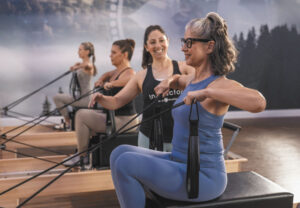
A woman who has never touched a barbell, and has no intention of starting, can still meet every criterion the ACSM Position Stand lays out. Progressive overload, the mechanism underlying its findings, is not a barbell-specific concept. It is a training principle: the gradual, planned increase of demand placed on the body so muscle, connective tissue, and the nervous system are always adapting, never plateauing. In a Pilates studio, that principle shows up as spring load, tempo, range of motion, and how much of a person’s own body weight and control is asked of her — all increasing together as she moves through a structured level system rather than a single, static routine. A beginner starts with more spring assistance and simpler, supported positions. As she progresses, spring tension decreases, positions move from seated to kneeling to standing, and her base of support narrows, asking her body to generate and control more of the force on its own — the same escalating-demand curve ACSM describes, delivered through equipment most women find approachable from the first class.
Pilates satisfies the guideline’s other clarifications almost by design. Every class is built around controlled tempo and full range of motion, coached rather than guessed at. Clients train with intensity and effort, not to failure, which the Position Stand found unnecessary for most goals. And because a single exercise can be scaled by spring count, lever length, base of support, or tempo, a studio can deliver two structured sessions a week without a woman ever feeling like she’s starting over or hitting a wall she can’t get past — the accessibility and genuine progressive load that the research says produces results.
There is also a piece of this that goes beyond the reformer. Standing work — done on a stability chair, tower, or springboard wall — brings a woman’s full body weight back into play as resistance, the way walking or single-leg balance work does. That full-body loading directly trains the two things CDC names as the most modifiable risk factors for a fall: lower-body strength and balance. Given that CDC data attributes 88% of hip fractures among adults 65 and older to a fall, not low bone density alone, that standing work is one of the most protective things a woman can build into a weekly routine, at any age.
For decades, the fitness industry told women that strength training required specialized equipment, a training partner, or a body that already looked a certain way. The newest research says none of that is true. What it actually requires is consistency, controlled progression, and a program that meets a woman exactly where she is and asks a little more of her each time. She does not need to wait for a heavier plate or a “someday” version of herself that feels ready. She needs a coach who will not let her plateau and two sessions a week. Everything the research says she needs to build a longer, stronger life is sitting in a Pilates studio, waiting for her to walk in.
Shannon Willits, Master Pilates Educator
Shannon Willits is a Master Pilates Educator with more than 25 years of experience in functional movement, rehabilitation-informed training, and athletic performance. As the owner of seven growing Club Pilates studios in Lee County, Florida, she has become one of the region’s leading voices in Pilates education, mentoring and certifying aspiring instructors through comprehensive training programs rooted in movement science.
Shannon is STOTT Pilates certified, a Fellow of Applied Functional Science (FAFS), a Functional Golf Specialist, and a certified Gyrotonic® instructor. She is also an approved NPCP CEC Provider and the creator of the Pilates for Rotational Sports workshop, which blends performance training, injury prevention, and functional movement education for both athletes and instructors.