

By Dennis O. Sagini, MD
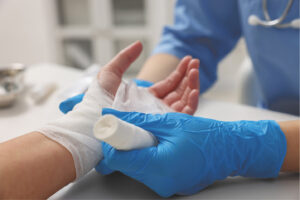 Think about the last hour of your life. You used your hands to make coffee, type a message, turn a steering wheel, hug someone you love.
We rely on our hands so constantly that we stop noticing them, until an accident reminds us exactly how much we need them.
Hand trauma is one of the most common reasons people end up in an emergency room, and it’s also one of the most misunderstood. A “minor” cut, a smashed finger in a car door, a fall onto an outstretched hand, a deep puncture from a kitchen knife—these moments can look small and feel survivable. But the hand is an extraordinarily complex structure, packing 27 bones, dozens of tendons, ligaments, nerves, and blood vessels into a space smaller than most dinner plates. There is very little room for error, and very little tissue to spare.
Why Hand Injuries Are Different
Unlike a broken bone in your leg, where surrounding muscle can sometimes compensate, the hand has almost no redundancy. Sever one tendon and a finger may never bend again. Crush one nerve and you may lose sensation permanently. Delay treatment on an open fracture and infection can spread through tendon sheaths in a matter of hours, threatening not just function but the limb itself.
I have seen patients delay care because the injury “didn’t look that bad.” A laceration that seemed shallow had actually nicked a flexor tendon. A jammed finger that swelled overnight turned out to be a fracture-dislocation requiring surgery. The visible damage to skin rarely tells the whole story of what’s happening underneath.
The Warning Signs You Should Never Ignore
Seek immediate evaluation if you experience any of the following after a hand injury:
. Inability to fully bend or straighten a finger
. Numbness, tingling, or loss of sensation
. A wound that won’t stop bleeding or appears deep
. Visible deformity or a joint that looks out of place
. Rapidly increasing swelling, especially with pain that feels disproportionate to the injury
. Any injury involving machinery, power tools, or animal bites
These aren’t reasons to “wait and see.” They are reasons to act now. The window for the best possible outcome in hand trauma is often measured in hours, not days.
Why Specialized Care Matters
General urgent care and even many emergency departments are not equipped to manage complex hand injuries. Reattaching a tendon, repairing a nerve under magnification, or stabilizing a small joint fracture requires the trained eye and microsurgical skill of a fellowship-trained hand specialist. The difference between general treatment and specialized care can be the difference between a hand that heals and one that never fully recovers its strength, dexterity, or feeling.
As an orthopaedic surgeon specializing in the hand, wrist, and elbow, I built my practice around a simple belief: every patient deserves the chance to get their full function back. That means accurate diagnosis from day one, a treatment plan tailored to how you actually use your hands—whether for surgery, art, sports, or simply holding your grandchild—and a recovery process that doesn’t stop until you do.
The Bottom Line
Your hands are irreplaceable tools that you will use every single day for the rest of your life. Treat every significant hand injury with the urgency it deserves. If you’ve experienced trauma to your hand, wrist, or elbow, don’t wait for it to get worse.
The choices made in the first hours after an injury often determine the outcome for the rest of your life. Don’t leave that outcome to chance, and don’t let uncertainty keep you from getting answers.
A short phone call today could be the difference between a full recovery and a lifetime of limitation.
Contact us today to schedule an evaluation with Dr. Dennis O. Sagini and protect the hands that carry your life forward.
Dennis O. Sagini, MD
Dr. Sagini is an orthopedic surgeon with specialization in hand and upper extremity surgery. He specializes in arthritis of the hand, nerve compression, muscle and tendon injury, fracture care, and upper extremity dysfunction.
He completed his Bachelors of Science in Microbiology from the University of Oklahoma in Norman, Oklahoma in 1998 and his Doctor of Medicine at Temple University in Philadelphia, PA in 2002. It was during medical school training that Dr. Sagini developed an interest in orthopaedic surgery. His residency in orthopaedic surgery was completed at Howard University Hospital, Washington, DC. Dr. Sagini completed his fellowship training in Hand and Upper Extremity surgery at the University of Pittsburgh Medical Center in Pittsburgh, PA.
Dr. Sagini is a member of the Lee County Medical Society, the American Association of Orthopedic Surgery and the American Board of Orthopedic Surgery.
Dr. Sagini is active in research and community service and has a passion for overseas medical mission work. He also enjoys running, traveling, listening to music, cooking, tennis, and spending time with his family and friends.
239-302-3216 | saginimd.com
13691 Metro Pkwy, Suite 400
Fort Myers, FL 33912